Jared Isaacman’s Major Artemis Update
NASA’s Artemis Update conference
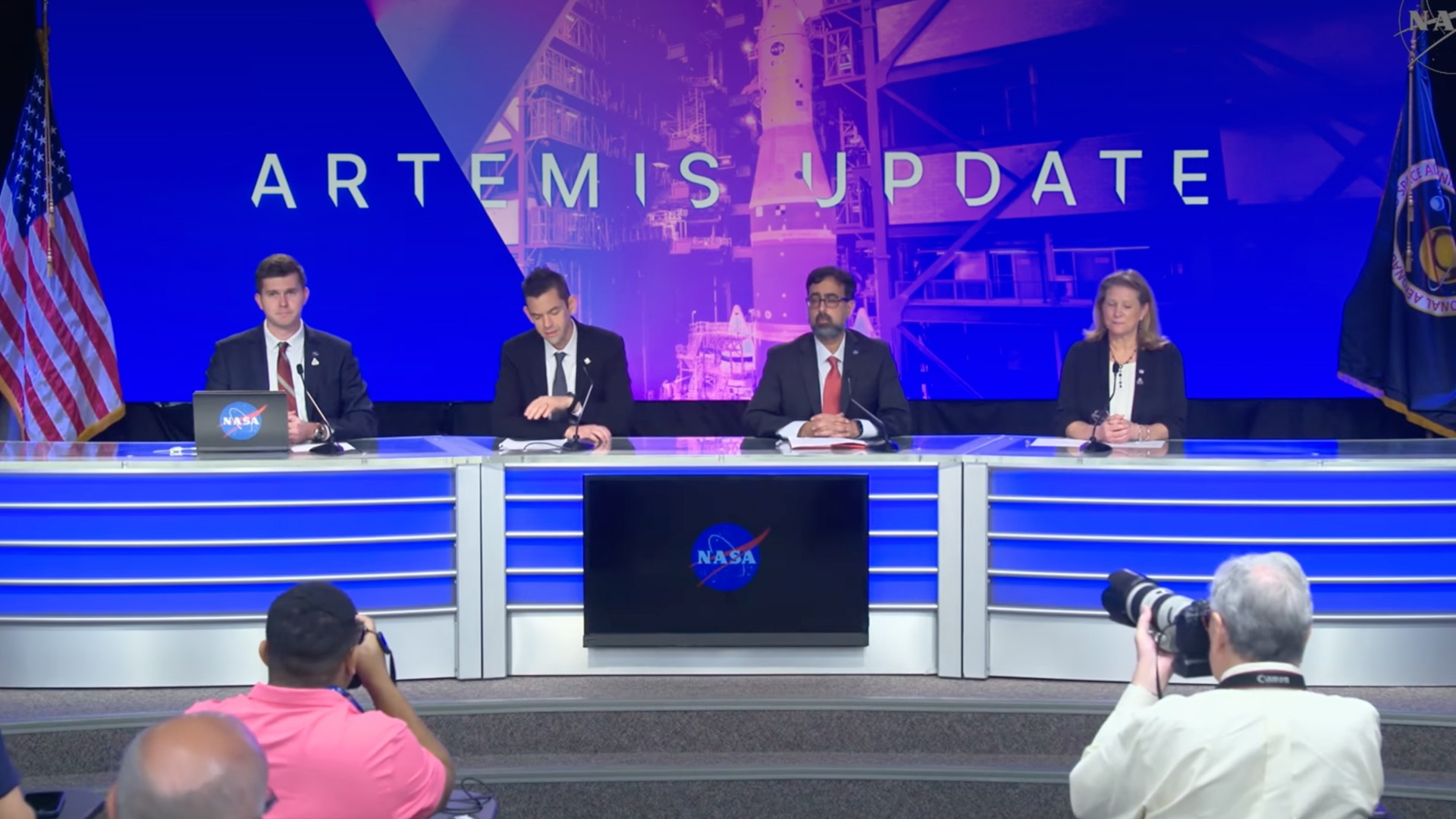
On Friday, 27th February, NASA held an Artemis programme update following the rollback of SLS to the VAB (Vehicle Assembly Building) after ICPS helium flow troubles. In attendance were NASA Administrator Jared Isaacman, NASA Associate Administrator Amit Kshatriya and NASA Moon to Mars Programme Manager Dr Lori Glaze, with the conference moderated by George Alderman, NASA's Deputy Press Secretary. Let’s now run through what was said during this update.
First up was Jared Isaacman, who started by thanking the workforce for their hard work during this campaign standard. But it immediately takes an interesting turn as he admits the current speed of the programme is absolutely not a path to success. Like me and many other spaceflight fans, we all knew this. SLS has been berated for its lack of flights and progress since its conception. For instance, if we were to compare to the Apollo Era, by the time Artemis II launches the Apollo Era would've been on its third lunar landing by now (Apollo 14), counting from Apollo 7. This is not good enough for NASA’s standards at all. SLS needs to fly more, and Artemis needs to accelerate in order to beat China to the Moon in the second space race.
The first major bomb of this update was the standardisation of the SLS fleet to a near block 1 configuration. Essentially this makes SLS Block 1b and beyond dead. The reason for this was to be able to get the workforce to be able to get the turnaround time between launches down to 10 months maximum; doing this builds muscle memory in the technicians and engineers, which they currently don’t have due to the length of time between missions. An example of this lack of muscle memory is how similar the issues were in both launch campaigns of Artemis I & II. Now this is not as easy as it sounds and will require a “rebuild and strengthen of the workforce” hinting that new and better-skilled workers will be required. Doing this will directly lead to an increase in launch cadence, according to the administrator.
Now what he says next is the big talking point, as if it couldn’t get any more interesting. Artemis III will no longer be a Moon landing. Instead a Low Earth Orbit (LEO) rendezvous mission with either one or both of the HLS contracted landers will take place in order to practise docking operations, a key part of the Artemis Moon landing architecture. This mission will also test out other key components, including ECLSS (Environmental Control and Life Support Systems) and potential components of the EVA suit developed by Axiom Space that will be used on the surface of the Moon. The re-profiled Artemis III mission will take place in mid-2027, making the lunar landings still targeted for 2028. Now, in 2028, there is a potential scenario where we get two lunar landings if the SLS turnaround time can get down to the 10-month target. These missions will be what Artemis III was supposed to be but instead were bumped up to Artemis IV & V.
Before we get into greater detail of the future of Artemis, let's give a briefing of Dr Lori Glaze's Artemis II update. Following the second and very successful Wet Dress Rehearsal (WDR), SLS and NASA were in a very good place and confident of an early March launch. As mentioned in the opening paragraph, a technical problem with the flow of helium to the ICPS (Interim Cryogenic Propulsion Stage) caused concern for the teams and eventually led to a rollback for the Artemis II launch stack. The issue occurred during the reconfiguration of SLS from WDR config to launch config. The specific problem was the flow to the RL-10 engine that powers the ICPS, and it resulted in a no-go situation. Helium is key in chilling down the engine to launch temperature to avoid thermal shock at ignition, as well as actuating key valves to enable propellant flow to the engine. A fix likely could've been done at the pad if they had access to the ICPS, but they didn't, so a rollback was the only option. Teams working in the VAB will also conduct more work on the whole vehicle, such as replacing the battery in the FTS systems; the Closeout crew will have another run through of their procedures; the Tail Service Mast Umbilical (TSMU) LOX (liquid oxygen) seal will be replaced to ensure acceptable tightness; and stowed items in the Orion capsule will be replaced too. Dr Lori Glaze insists updates will be given when possible to keep up with the progress of work to the Artemis II launch vehicle.
Updated Artemis III Mission
Artemis III, as mentioned, has been re-profiled to a LEO rendezvous and docking mission involving one or both HLS landers. The two HLS contracted landers are SpaceX’s Starship HLS version and Blue Origin's Blue Moon lander. The lander, whether it's one or both used in Artemis III, will depend on vehicle readiness by the time the mission comes around.
Although the mission is in early planning and vehicle readiness is still unknown, we can make a pretty decent guess to what will happen during this mission. For this example, let's hypothetically say both HLS vehicles are ready for the mission, and also this is all an educated guess on my part, and this is a likely scenario in my opinion.
To start, SpaceX and Blue Origin will launch their landers into LEO, test out their ECLSS and power generation (deploying solar panels) and get them into docking-ready configuration. Once all systems have been tested and vehicles are in good condition for docking, I think that’s the point the Artemis III SLS stack and crew will launch. It makes sense to launch the landers first, as you don’t want to waste an SLS stack and crew time if the landers aren't in a test-ready situation. Now this is where things may become tricky or relatively straightforward. Starship and Blue Moon will either be in close proximity to each other or could be far away from each other; nobody will know until exact mission parameters are set. My guess is that both landers will be in relatively close proximity to allow for an easier path to two docking attempts. Once Orion catches up to the landers and is in proximity to the two vehicles, checks would be performed to verify all systems are go for docking. Once verified, Orion will begin to close in on one of the vehicles ahead of mating. For this example, we’ll use Starship as the first docking attempt. Once Orion closes in on Starship, an opportunity for the crew to take over may be worthwhile. Crew capability to manually dock Orion to the landers is essential in the event the autodock fails in some way, as without the ability to dock you are not getting home from the moon. I believe it will be beneficial to test that capability in LEO rather than having to do it for the first time in NRHO (Near-Rectilinear Halo Orbit) around the moon. Crew capability is being demonstrated on Artemis II following Orion/ICPS separation. Artemis II pilot Victor Glover will take manual control of the spacecraft and perform a series of close proximity operations with the ICPS stage acting as a target. However, no docking will take place, making it, in my opinion, a welcomed test/demonstration on Artemis III. Once docked, crew ingress operations will take place with the crew transferring to the Starship lander. Upon entering the Starship spacecraft, the crew will test and inspect every inch of the lander, giving feedback to teams down on the ground. As well as using the time to get used to the feels of the massive Starship vehicle. They may even potentially have a go at the wheel, doing some small manoeuvring of the vehicle. Once all operations are complete, the crew will transfer back to Orion ahead of undocking. Undocking will then take place, and it will back away from Starship and perform a series of manoeuvres to navigate towards the Blue Moon lander.
Once it's within proximity of Blue Moon, the docking procedures will more or less be the same; instead, this time the autodock will be used to test the primary docking method. Again, crew ingress will take place, and the crew will get a feel for the lander ahead of their return to Earth.
A new redesigned heatshield will fly on Artemis III following Artemis I’s heatshield issues, so this will be another major test for NASA and Orion. A re-entry trajectory will be established, and Orion and the crew of Artemis III will prepare for atmospheric re-entry and splashdown.
This will conclude the Artemis III mission, but it may not conclude the mission for Starship and Blue Moon... SpaceX and Blue Origin are required to perform one successful uncrewed landing on the lunar surface before a crewed landing can take place. Depending on how kitted out each vehicle is and how confident each company is, the uncrewed lander may take place following the conclusion of Artemis III. I think it would definitely make sense for SpaceX and Blue Origin to take this opportunity to land, even if they aren't super confident of success. They may as well learn some lessons about their vehicles rather than leave them in LEO or even deorbit them and watch them burn up.
That’s what I think could very well be a possible mission profile for Artemis III; whether it will look similar to this or vastly different, only time will tell.
SLS Standardisation
SLS has now been standardised to a “near Block 1 configuration” as stated by NASA Administrator Jared Isaacman. This is to simplify the production of the rocket to enable faster turnarounds between mission as it will help build muscle memory within the workforce. What does this actually mean though? What will happen to future stages that were contracted by NASA? Lets find out.
First of all lets take a look at the current SLS configuration.
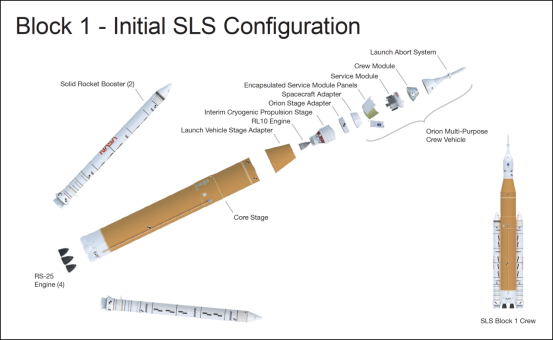
NASA’s SLS block 1 configuration
This is the current SLS configuration that is flying on Artemis I, II and will fly Artemis III.
Here’s an article written by me explaining each component of SLS block 1: https://www.theweeklyspaceman.com/articles/sls-and-orion
Many aspects and components of the Block 1 variant will be removed and upgraded in the Block 1b variant. However, future versions have now been scrapped. Before we get into what will happen next, we need to take a look at what components will be upgraded. The Interim Cryogenic Propulsion Stage (ICPS), as the name suggests, is just a placeholder stage until the Exploration Upper Stage (EUS) is ready for flight. So that’s the first major change, the upper stage. The EUS is a more powerful and capable stage compared to the ICPS and will increase payload to the moon by ~40% (27t to 38t). A 4x increase in thrust enables this massive payload increase, with the stage producing 97,000 lbf compared to the ICPS’ 24,750 lbf. The EUS is a completely new design unlike the ICPS that is derived from the DCSS (Delta Cryogenic Second Stage) used on the Delta rocket family. This new design increases the diameter to match that of the core stage. This then affects the Launch Vehicle Stage Adapter (LVSA), which will be removed and replaced by a standard interstage that will house the 4 RL 10 C-3 engines of the EUS. The next change isn't a replacement but more of an addition to the stack to allow larger payloads to be carried to the moon. With an internal volume of 10,100 cubic feet, a maximum of 15 27U cubesats (34 cm x 35 cm x 36 cm) can be launched on the rocket and deployed from the New Explorations Secondary Transport component (NEST).
However, as we said, block 1b will be scrapped. So what does this mean for the EUS, for NEST and for all the other changes proposed for block 1b? Truthfully, nobody knows. Jared Isaacman and NASA probably aren’t 100% sure as of right now either. This bombshell was dropped only a couple of days ago, so anything you read that isn’t directly from NASA is just speculation. Although there are a few options on the table.
First of all, the NEST has likely been scrapped if they want to keep it to a “near-block 1 configuration”. So the only real change will be the upper stage, and there are a few options available to NASA.
Option 1 is to keep the contracted EUS and apply it to the current SLS configuration.
Option 2 is to use Vulcan's Centaur V stage. This has been hinted at in an official NASA illustration showing a Centaur V carrying Orion to the moon.
Option 3 is to use the New Glenn upper stage GS-2. A powerful second stage that has already launched NASA payloads to Mars.
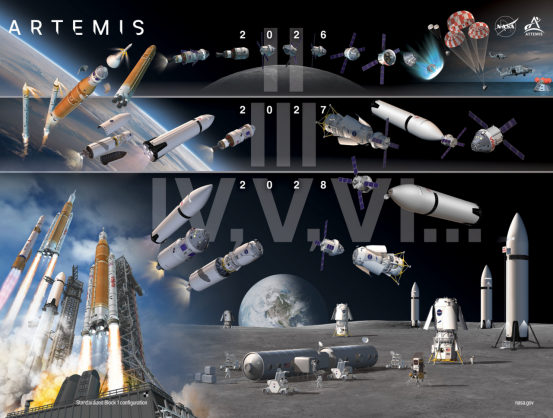
Official NASA graphic posted by Jared Isaacman with the caption “this is how we’re going back”
On the graphic you can see the Centaur V stage carrying Orion if you look between the Starship HLS and Blue Moon HLS attached to New Glenn's second stage.
In my opinion, I think the EUS is the likely option. It's already contracted and would have to be cancelled through Congress. It’s a perfectly capable stage for this application, and with it already in production, I don’t personally see the benefit in ending the contract now.
The Centaur V is the second most likely option in my opinion, mainly due to the fact it's used in the official graphic.
And New Glenn's second stage is the least likely option due to its massive size compared to the other two options.
Personal Thoughts
Personally, Jared Isaacman has been absolutely incredible since coming into the administrator role at NASA. He's taken the time to soak in the culture while also vastly improving it. The streamlining of production and standardising SLS is incredibly smart and has been called for for years. SLS’s job should be launching the Orion spacecraft, and that’s all. SLS does not need to be a cargo launcher, and in my opinion it was idiotic to try and make it one considering it was flying once every three years. Leave the cargo launches to commercial partners like SpaceX and Blue Origin. Getting the launch cadence up and improving muscle memory is also such a basic thing previous administrators must've thought of, but they never did. I also think it’s a great idea to re-profile Artemis III as going from a lunar fly-by to a lunar landing. It is an incredibly bold step that the Apollo era didn’t even do.
Overall, Jared Isaacman has paved a way for Artemis to be a sustainable programme that could actually reach mission Artemis 100, as Jared says.
We are the Artemis generation, and we are going back, this time to stay.
Thanks for reading, and any feedback, negative or positive, is appreciated.