Space Weekly #2
Welcome back to The Weekly Spaceman’s 2nd Space Weekly article. A quieter week compared to last week in the world of spaceflight, but all the major news stories from the past 7 days are very interesting. Enough yapping, let's head straight into it!
Starship Super Heavy
Once again kicking things off down at Starbase, we have had a busy and exciting week! Booster 19 has been going through a careful and patient testing campaign ahead of flight 12, which SpaceX is absolutely banking on success with. When we last left off with last week's news, Booster 19 had just been lifted onto the launch mount at pad 2. On Tuesday, 10th March, SpaceX was preparing for the first propellant loading test of pad 2, an important step ahead of the V3 debut. With the road closed at 8am and the tank farm spooled up, SpaceX and booster 19 got into propellant loading at around 11am. This is when we saw the true upgrades at the second Starbase launch pad really come into play with the propellant being loaded in around 30 or so minutes! For the first test it was a partial load of the fuel (CH4/liquid methane) tank and a full load of the oxidiser (LOX/liquid oxygen) tank. For a sense of how insane this speed of propellant loading truly is, they’ve filled the equivalent of 10 Falcon 9 rockets in roughly the same amount of time it actually takes a Falcon 9 to load all of its propellant.
The following night, on 11th March, SpaceX was ready to load up some propellant once again. With the original road closure end being pushed till 11pm, it was obvious SpaceX had some troubleshooting or just simply wasn't ready for the day. No issue, though, as teams carried out the same propellant loading sequence at roughly 7:48pm.
All was going so well for Booster 19 until we saw road closures being removed and a transport stand start rolling down the highway. Booster 19 began its rise off of the launch mount, and the fear of rollback kicked in. But fear not! The removal of Booster 19 was purely for a little bit of work on the aft section of the booster. This wasn’t necessary on pad 1 due to the flat surface of the deluge plate. However, Pad 2 has a flame trench after a valuable lesson was learnt from Pad 1, meaning just simply lifting the booster off the launch mount is actually so much quicker than figuring out how to get a servicing platform under the booster.
Following the repair work, just 26 hours later Booster 19 was rising once again, being placed onto the launch mount within 10 minutes. The chopsticks are making light work of Super Heavy.
Then yesterday, Sunday the 15th, SpaceX got ready for another round of testing. Prop load began at around 9am, and Booster 19 once again had a partial fuel load and a full LOX load. Once prop load was complete, an igniter and spin prime test of the Raptor 3 engines were conducted.
Here is a clip. CSI Starbase took from Avid Space’s 24/7 cameras showing the test beautifully: https://x.com/CSI_Starbase/status/2033196482182992331
In other Starship related news, NASASpaceFlight caught the final 2 tower modules rolling ahead of shipping to LC-37 during their The Flame Trench News show. This will be the 4th Starship tower, emphasising SpaceX’s intensions in terms of their “airline like cadence”.
NASA Artemis II
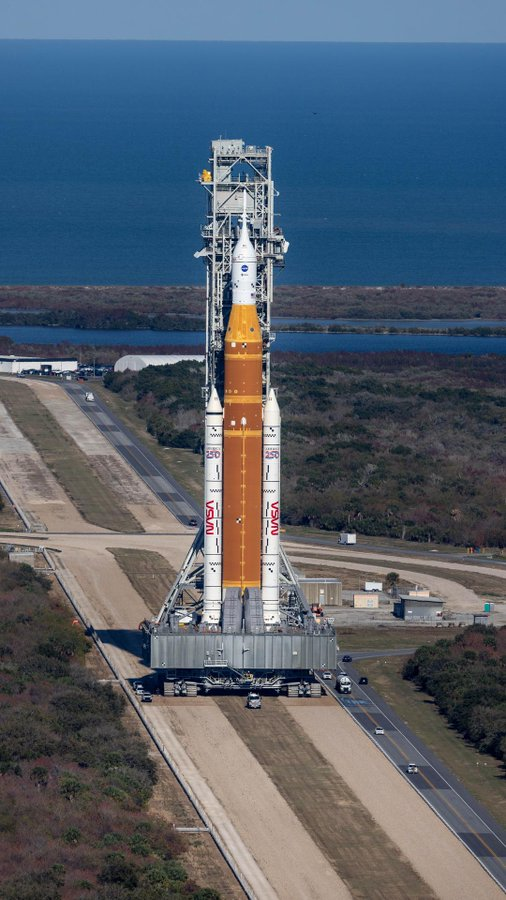
SLS rollback
Credit: NASA
After such a positive wet dress rehearsal test on February 20th, the news of a rollback due to helium flow issues on the ICPS upper stage was disheartening. However, following repair work in the VAB in the last few weeks, NASA is now preparing to roll out the Artemis II SLS & Orion stack once again on Thursday the 19th. This comes following a very successful Flight Readiness Review (FRR) from the mission management team and other teams involved in this mission. This was conducted on Thursday, 12th March, and everyone polled GO, with teams now preparing for an April 1st launch attempt. April 1st is a daytime launch opportunity, which is nice and was the only daytime launch in this window. Until Dr Lori Glaze announced during a post-FRR conference that April 2nd was added to the window, which is also a daytime launch. This is the latest timeline given to us, and we will certainly keep an eye out on socials for a 100% confirmation of SLS’s rollout on Thursday. Another telling sign will be a confirmation of the Artemis II astronauts heading into quarantine within the next few days.
HLS OIG Report
On March 10th the NASA Office of Inspector General (OIG) report on the progress of both HLS programmes was released. Before we get into the details, this report was conducted and written before Nasa administrator Jared Isaacman rearranged the Artemis missions.
An OIG report is basically an assessment of how efficiently a programme is running. This particular report on SpaceX's and Blue Origin's HLS proposals had some interesting details in it.
Starting off with the basics, OIG found that this programme was actually being run relatively efficiently with costs for Starship and Blue Moon increasing by 6% and 1%, respectively. Which is good; however, it does express the delays with a rather disappointing tone. Let's move on to the lander issues, starting with SpaceX.
SpaceX had a troubled start to the V2 Starship, with each failure delaying progress by a couple of months. This has subsequently delayed a lunar landing, forcing Jared Isaacman into reprofiling Artemis missions using “accelerated proposals". With Starship HLS utilising a more or less V3 Starship design which is set to debut next month, a lot needs to be figured out and quickly, according to this report. The main concern from the OIG is the transferring of cryogenic propellants as well as the flight rate of Starship. These two watch items and technological advancements are key in SpaceX’s current HLS plans due to Starship's architecture. Another concern from NASA’s side is the lack of manual control on Starship. Now this is a tricky one, as SpaceX does not want manual control on Starship, whereas NASA does. Controlling Starship is one of the most badass things someone could possibly do, although it will be extremely tricky to try and land it on the moon. When we say ‘manual control', we don’t mean the mission pilot has to fly it manually from Earth orbit to the lunar surface; we are talking about emergency situations. In my opinion, manual control is a must. Every Apollo-era moon landing required manual control, and even though flight computers and navigation systems have significantly improved, malfunctions, bugs and glitches can still happen in these vehicles. Concerns surrounding the likeliness of the vehicle tipping over have also been raised, with a maximum of 8 degrees of tilt tolerance.
Blue Origin has also faced delays to their lander, with most issues and concerns being similar to SpaceX’s. Blue Origin's current proposal requires multiple refuelling trips from their Blue Ring spacecraft, which has yet to fly or be constructed. However, they might put their foot slightly ahead of SpaceX with their Blue Moon Mk1 lander getting ready to fly soon. This will give Blue Origin a valuable experience in operating spacecraft in lunar space.
To summarise this report, there are ongoing issues with the HLS landers and final vehicle designs, and accelerated timelines are still being assessed with key discussions and decisions to be made. Although the efficiency of the program is pretty good, the troubles of respective development have caused delays to the overall timeline.
The whole document makes an interesting read, if your interested in the full document the link is here: https://oig.nasa.gov/wp-content/uploads/2026/03/final-report-ig-26-004-nasas-management-of-the-human-landing-system-contracts.pdf
ESCAPADE Gold and Blue
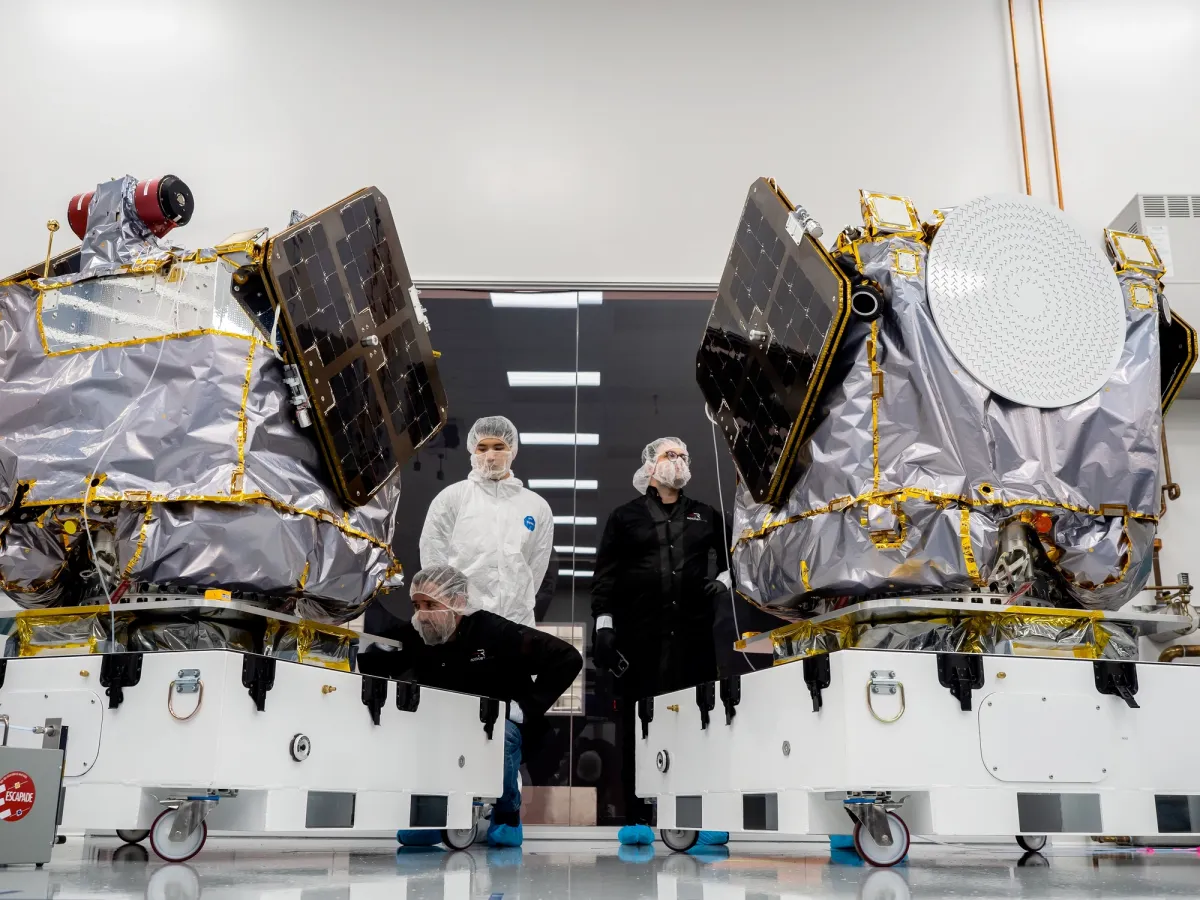
ESACAPDE Blue and Gold in the factory pre-launch
Credit: RocketLab
Rocket Lab’s ESCAPADE mission is a twin spacecraft mission to Mars to study solar winds interacts with the magnetosphere of the red planet. These small twins, Gold and Blue, launched on Blue Origins New Glenn rocket on November 13 2025.
On Monday 9th March, Rocket Lab made an X post stating that scientific operations have begun on the spacecraft. The science specifically mentioned is the study of Earths magnetotail ,with the spacecraft being the first to do so from such a distance. Blue and Gold will reach Mars’s orbit in September 2027.
The First
100 years ago today (March 16, 1926), the first-ever liquid-fuelled rocket took flight. Robert H. Goddard’s rocket flew up to a 41 ft altitude, with the flight lasting 2.5 seconds. Ever since this demonstration, liquid-fuelled rockets have been the standard. A nice history lesson to finish off this week's space news.
As of final formatting, Booster 19 conducted a static fire test! More next week. ;)
Thank you all for reading, and apologies for the slight delay.
Follow The Weekly Spaceman on X here: https://x.com/TWSsocials