“Onward and Upward”: Isar Aerospace is ready to try again
Nearly a year after the failure of the first test flight of Isar Aerospace’s Spectrum rocket, on March 30th, 2025, the company is ready for a second attempt at becoming the first commercial European company to reach orbit as soon as today, with a 1-hour launch window opening at 20:00 UTC (21:00 CET).
The main objective of this qualification flight is to demonstrate Spectrum’s capabilities, reach orbit, and deploy payloads.
Header pic credit: Isar Aerospace
Isar Aerospace
Isar Aerospace was founded in March 2018 with the goal of becoming a leading space company in Europe and globally, enabling cost-effective, safe, reliable, and sustainable access to space. Over the past years, the employees at Isar Aerospace (who are now more than 400 from 50 different nations) have been working on designing and manufacturing their Spectrum rocket, with the development that started around September 2020 with the goal of producing at least 80% of their rocket in-house.
Spectrum
Spectrum is an orbital launch vehicle consists of 2 stages:
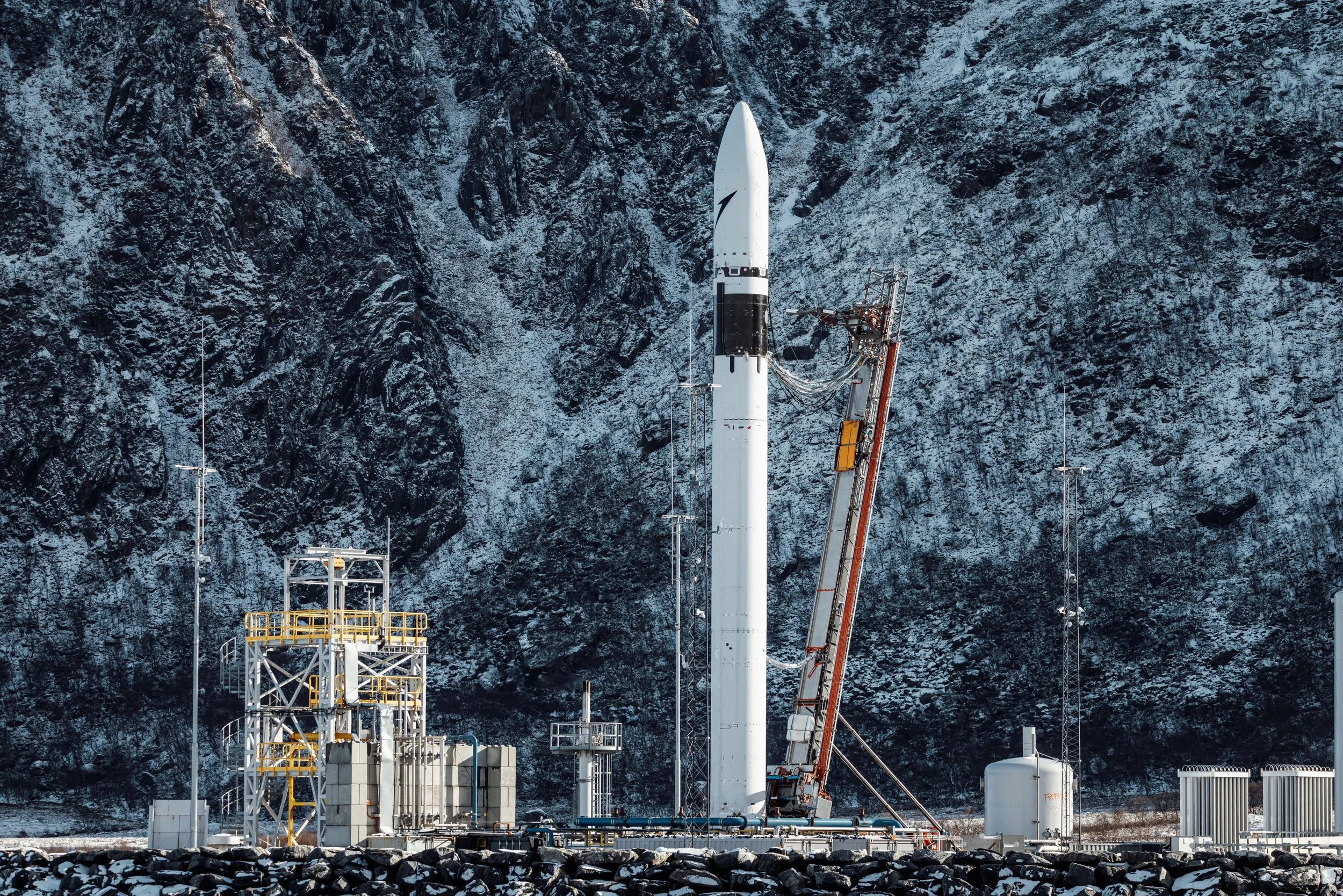
Spectrum rocket at the pad. Credit: Isar Aerospace
The first stage, made of carbon composites, is powered by 9 Aquila engines; these engines are gas-generator cycle engines (like the Merlin engines on Falcon 9), where a small amount of fuel and oxidizer is burned in a gas generator (the preburner) to power the turbopumps with their exhaust. Each Aquila engine produces 75 kN of thrust at sea level, providing the necessary thrust to lift off and deliver the payloads to orbit. The first stage conducted a 9-engine, 30-second-long integrated static fire in December 2025.
The second stage is made of carbon composites as well, and it’s powered by a single Aquila Vacuum engine, whose thrust is 95 kN. The second stage has multi-ignition capabilities, allowing the rocket to deliver payloads to their desired orbit without the addition of a kick stage (like Electron has). Atop the second stage, the fairing encloses the payload, which, as we’ve said, can weigh up to 1000 kg to LEO or 700 kg to SSO. Spectrum’s payload capabilities can offer a single dedicated payload, a multi-payload, or even a rideshare mission to a predefined orbit. The second stage conducted its integrated static fire in December 2025, a few days earlier than the first stage.
Both stages use liquid oxygen as oxidizer and propane as propellant, allowing a cleaner burn compared to other similar rockets. Overall, Spectrum is 28 m high and 2 m wide.
Isar Aerospace has manufactured Spectrum in-house with technologically advanced manufacturing processes, such as additive manufacturing, 3D printing (for the nozzle and combustion chamber of Aquila, among others), and carbon composites development.
First flight
The first flight of Spectrum launched on March 30th, 2025. After a nominal liftoff, the rocket started losing control approximately 15 seconds into flight, swerving both ways before turning over; at that point, the AFTS (Autonomous Flight Termination System) activated and shut down the engines, letting the rocket fall and explode near the pad about 40 seconds after liftoff; however, the company declared that the launch pad wasn’t damaged by the launch failure.
Following the first flight, Isar kept working on its Flight 2 vehicle, which was already under production, and shipped both stages to the launch site at Andoya, Norway, in mid-November 2025. There, they both conducted several tests, culminating in a 30-second-long integrated static fire for both stages in the month of December.
After payload integration, the rocket rolled out to the pad ahead of a launch attempt on January 21st. However, this attempt was scrubbed due to an issue with a pressurization valve, and once resolved, the new window would open roughly 2 months later, on March 19th. The launch then slipped a few days due to weather until finally reaching the March 25th date.
“Onward and Upward”: pushing Europe’s capabilities
With this launch, pending success, Isar Aerospace intends to become the first European launch provider to reach orbit and deploy payloads. This would be a huge step forward both for the company and for Europe as a whole, as it would mark the start of a new era of independent, frequent launches; currently, Europe only launches government-made rockets, Ariane 6 and Vega C, from the Guyana Space Center in South America.
Having one or more commercial launch providers would allow launching European payloads from European soil, without having to ship, assemble, and launch the rocket and payload from a whole other continent.
Mission profile
The mission profile for this mission is relatively straightforward: following launch under the power of 9 Aquila engines, Spectrum will pitch downrange to build the horizontal velocity needed to reach orbit. About a minute into flight, the rocket will experience Max-Q, or the moment of peak mechanical stress on the rocket due to the increased speed and decreased pressure.
About 2.5 minutes into flight, the rocket will undergo stage separation, where the first stage will shut down its engines, followed by the separation of the two stages and ignition of the upper stage’s Aquila Vacuum engine. After a flight phase, the rocket will reach orbit, deploy its 5 Cubesats, and then perform a deorbit burn, serving as both a demonstration of the rocket’s relight capabilities and avoiding an uncontrolled reentry in the future.
Payloads
“Onward and Upward” will be Isar’s first flight carrying payloads under ESA’s BOOST! program, which allows student and educational teams to develop and launch cubesats in space. The payloads will include 5 deployable cubesats and 1 onboard experiment, so let’s briefly see them:
CyBEEsat: this 1U cubesat, weighing only 1 kg, is developed by the Technische Universitat Berlin to demonstrate a miniaturized transceiver for the Short Duration Mission (SDM) frequency, featuring innovative onboard hardware and radiation-tolerant solar cells.
TRISAT-S: developed by the University of Maribor and Skylabs, Slovenia, this 3U, 5-kg cubesat aims to demonstrate 2 key technologies for future deep-space exploration: advanced battery hibernation performance and ultra-miniaturized imaging-based navigation.
For the primary objective, teams will evaluate the performance of their exceptionally low self-discharge rate primary batteries after periods of hibernation controlled by an ultra-low-power timing element, a key feature for future deep-space missions that will remain dormant for a long time. Sensors will also evaluate the battery chemistry, radiation effects, and lifetime prediction.
A secondary objective includes demonstrating a next-generation, ultra-low-power, ultra-miniaturized imaging system providing a full view for attitude and orbit determination, a key precursor for future autonomous navigation in deep space.
PLATFORM-6: a platform developed by EnduroSAT, able to carry satellites and payloads. The exact specifics of this payload are unknown.
FramSat-1: this cubesat is developed by Orbit NTNU (Norway) and will be hosting Eidsvoll Electronic AS’ newly developed sun sensor for testing.
SpaceTeamSat-1: developed by the Austrian TU Wein Space Team, this 1U, 1-kg cubesat has been developed for educational purposes: onboard, there are several temperature sensors, an accelerometer, a gyroscope, a magnetic field sensor, a UV sensor, a dosimeter, 2 cameras, and sensors to measure the current and voltage of the solar panels and batteries, as well as a Raspberry Pi educational payload; students will use all these sensors and instruments to test their own developed code and compete for measurements, images, and videos, enabling countless software projects.
Let it go: this non-deployable experiment from in-space manufacturing company Dcubed will test the deployment of low-shock actuators for cubesats in space while attached to the payload adapter.
References
