Let’s go - Artemis II Flight Day 1
Header pic credits to Andrew McCarthy
Welcome to the first of many Artemis II-related content brought to you by us, The Weekly Spaceman!
You can expect daily coverage by us, where we’ll go through each of the flight test’s activities day by day to give you every piece of information you need to know.
The mission will be composed of 10 Flight Days (FDs), with the first one starting at L-7 hours and ending at L+17h. Let’s take a look at what they did:
L-7h
When FD1 started, at L-7h, the crew was having breakfast and undergoing final medical checkouts before suit donning, while the rocket was loading propellants in its tanks.
The countdown proceeded well: on the crew side, the astronauts started donning their suits at L-5h40m and exited the O&C (Operations and Checkout) building roughly an hour later for final greetings to their families and the general public.
They boarded the special Artemis van that took them to LC-39B, where the closeout crew had been waiting for them, preparing the capsule for their arrival; once there, they signed their iconic names on the wall of the white room before donning the gloves and helmets and being helped into Orion’s seats.
Once in the correct position, the closeout crew began configuring the spacecraft for launch: they installed the counterbalance mechanism on the Orion hatch, which helps distribute mechanical loads and therefore decreases the stress on the joints when it’s opened, and they also conducted pressure decay checks to verify the integrity and stability of the system.
Afterwards, they worked on the LAS (Launch Abort System) hatch, running a little bit behind schedule, but in the end both hatches (LAS and Orion) were closed successfully, and the closeout crew departed from the launch complex at less than 45 minutes to launch.
As for the vehicle side, when FD1 started, the rocket was loading propellants onto its tanks, reaching full replenishment mode by T-5h. Although the rocket had finished major events until terminal count, a couple of issues popped up: first, ground control was having problems communicating with the FTS (Flight Termination System, explosive charges that blow up the rocket if something goes wrong), meaning they were NO-GO on the range for a little bit; however, they solved the issue by sending the FTS lead engineer to the VAB to take a piece of hardware from the Shuttle missions to test the communication systems and find a solution. With this innovative problem-solving mindset, teams were able to come to a solution rather quickly.
Another issue, later into the countdown, was related to high temperatures on one of the two LAS batteries, but after thorough evaluation they declared it was a simple instrumentation issue.
Terminal count
Teams held at T-10 minutes for roughly 11 minutes as teams closed the last open items before terminal count. At that time, our heroic crew also said a few last words:
Victor: “We are going for our families.”
Christina: “We are going for our teammates.”
Jeremy: “We are going for all humanity.”
And then, the clock started to tick down again, and step by step we were getting closer to liftoff: at T-8m, the Crew Access Arm (CAA) retracted; at T-6m, the core stage began pressurizing its tanks, Orion was set to internal power, and its ascent pyros were armed.
A few seconds later, the LAS was armed, ready to get the crew to safety in the event of an emergency.
At T-4m, the core stage APU (Auxiliary Power Unit) was powered up, giving hydraulic power to the RS-25’s TVC (Thrust Vector Control) system, which steers the engine.
At T-2m the ICPS and boosters switched to internal power, followed by the core stage a few seconds later.
At T-30s, the GLS gave the control of the rocket to the ALS (Autonomous Launch Sequencer), ready for liftoff. A few seconds later, the igniters started up, eliminating hazardous volatile elements that would bring a risk of explosion at startup.
The water came up at T-10s, followed a few seconds later by RS-25 ignition and booster ignition, marking the liftoff of the first crewed mission to the Moon in more than 53 years.
Launch and on-orbit operations for the day
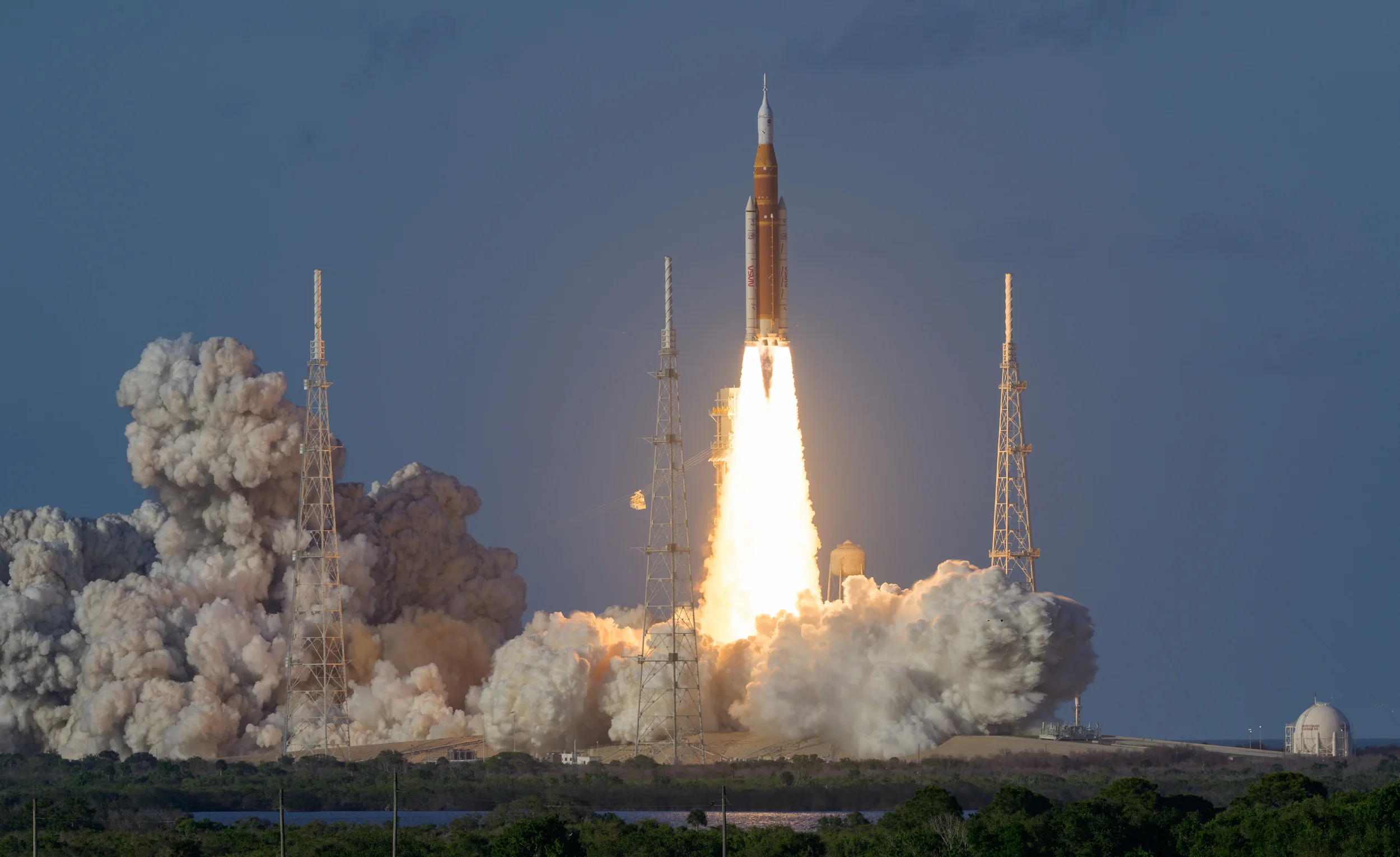
Artemis II launch. Credit: NASA
A few seconds after a successful launch, the rocket began the roll and pitch maneuver, flying downrange to target the expected 28.5-degree orbit.
For the first time in more than 50 years, astronauts were flying to the Moon; the rocket was ascending into the sky, witnessed by tens of millions of people worldwide, as it flew farther and farther into the distance, higher and higher towards the stars. The mission was not just for the astronauts, but for all of us. To inspire, to test, to explore, and to never stop again.
About a minute into the flight, the rocket passed through the moment of peak mechanical stresses, named Max-Q, and roughly a minute later, the twin SRBs(Solid Rocket Boosters) separated from the rocket.
After about 3 minutes into flight, the protective covers were ejected, and the LAS (Launch Abort System) was fired away since the environment allowed Orion to abort on its own if needed.
After another 5 minutes of powered flight, the core stage shut down its 4 RS-25 engines, and the ICPS upper stage with the Orion capsule on top separated from the rocket, with breathtaking views to go alongside the separation!
The rocket left Orion and the ICPS in a suborbital 27 x 2222 km orbit, used by the crew and ground teams to verify the capsule’s functionality ahead of committing to an orbit.
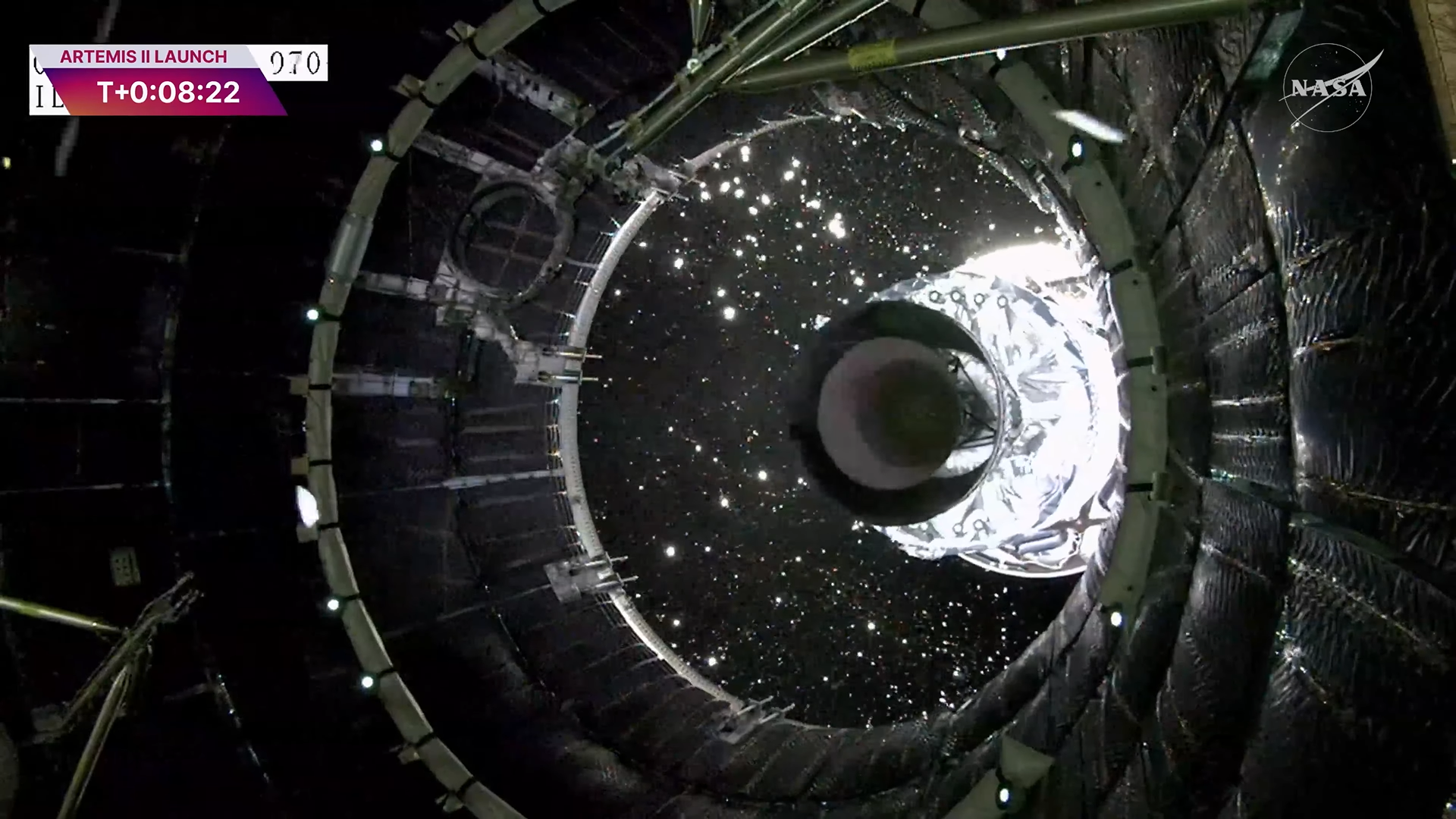
ICPS separation. Credit: NASA
Unlike other launches, the upper stage didn’t immediately ignite since the 29.700 km/h speed provided by the core stage and SRBs was enough to let the rest of the rocket take half an orbit before igniting… and so it did.
At roughly 49 minutes into the launch, the ICPS ignited its RL10-C engine for the first time for 26 seconds, raising the perigee to 160-180 km, in a maneuver called PRB (Perigee Raise Burn).
At this point, having reached apogee, the crew of Artemis II already broke a record for being the farthest humans ever gone from Earth since 1972 and the highest in an Earth orbit, as the previous record was set by the Polaris Dawn crew in 2024 at a little more than 1400 km.
Once in a stable orbit around the Earth, the crew waited another hour until T+1h49m, when they conducted an ARB (Apogee Raise Burn). This 18-minute-long burn almost completely depleted the ICPS of propellant, but it pushed the spacecraft into another suborbital trajectory around Earth, roughly -2 x 70385 km. Once again, this trajectory was meant to have the spacecraft in a safe orbit where they would safely reenter should any issue have occurred.
Having reached this orbit, the crew took off their launch & entry suits and got into more comfortable clothing while activating the DCAMs (Docking CAMeras) to check they worked.
After a brief PAO moment (Public Affairs Office, basically press conference or public event) where the crew checked the main systems were working, Reid and Victor got into their seats (with Jeremy and Christina at their side) to conduct the proximity operations demonstration.
Victor manually flew the Orion spacecraft towards, away from, and around the discarded ICPS upper stage, between distances of 9 and 90 meters, in order to test the spacecraft’s manual piloting and inform future ground simulators with real-life handling experience for better training.
After the ICPS separated, at T+3h20m, Victor turned the spacecraft around, facing the ICPS. There, it tested 6DOF (6 Degrees Of Freedom) before maneuvering towards the first docking target on the ICPS tip; the spacecraft then translated to the side where the second docking target was positioned and performed similar operations, which appeared to go flawlessly.
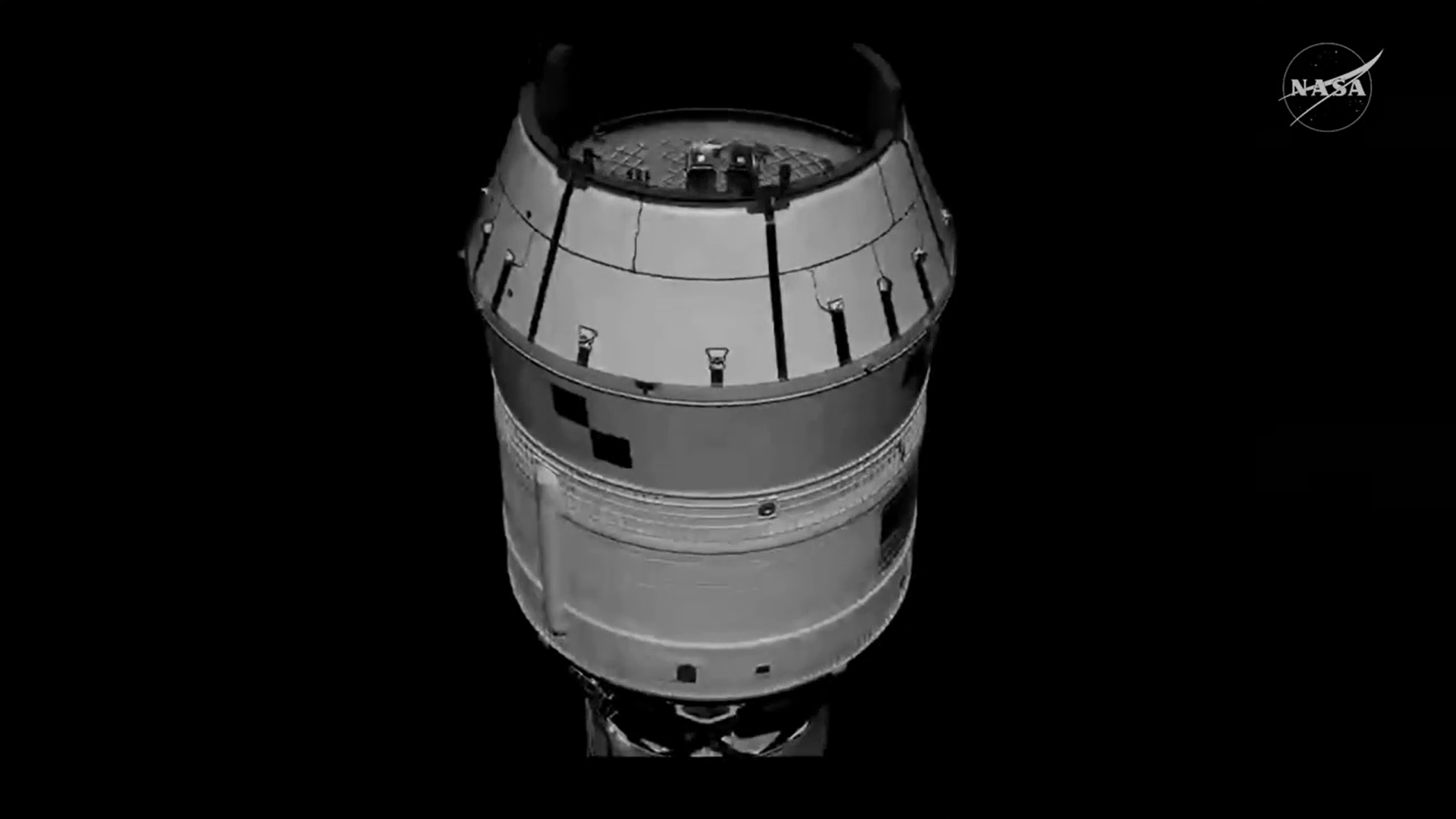
ICPS being used as a target for the prox-ops demo. Credit: NASA
The demo lasted for roughly 1.5 hours before Orion turned away from the ICPS and ignited its engine for USS2 (Upper Stage Separation burn 2) at T+4h52m, which set the spacecraft on a course away from the upper stage, after which the latter performed a deorbit burn about 8 minutes later before deploying the 4 cubesats, whose fate is still unknown.
After USS2, the crew onboard Orion configured the cabin for staying in space, encoded the 4K footage to send on the ground, and checked that the cabin’s environmental control system was working correctly. After this, they also conducted an initial medical check to ensure everyone was fine.
There were a few issues nonetheless: at T+51 minutes, there was a brief, partial loss of communications during a planned handover between satellites, where the crew could hear the ground but not viceversa; this issue was resolved and was being looked into.
Additionally, a valve connecting 2 pairs of water tanks to ensure maximum flow that was supposed to be open had been closed by the launch vibration, requiring troubleshooting; a minor issue with a piece of electronics due to radiation exposure was also detected, but it did not cause anything major.
And, worst for last, the toilet didn’t work initially: there was a priming problem when they attempted to spin up the toilet, causing it to malfunction and not be eligible for use. Thanks to the work of Christina Koch, who self-defined herself as “space plumber,” in a matter of hours the toilet was up and working!
However, issues aside, this was an amazing start of day, and after conducting their nominal flight day with a beautiful launch and a beautiful stay in space, the crew got ready for its fragmentary sleep period: they started getting ready for sleep at T+7h but actually went to sleep at T+8h30m; however, they had to wake up after 4 hours to monitor the PRB (Perigee Raise Burn) at T+13h30m, which increased their perigee to a safe 160-180 km altitude. At that point, 70.000 km away from Earth, they were seeing Earth like no one had seen it before in a long time.
Right after this, they activated the DSN (Deep Space Network) and got back to sleep, while teams on the ground remotely activated the OpComm (Optical Communication) system, a laser communication system that allows for high-definition and high bandwidth streaming and data downlink.
This concluded the crew’s amazing first day.
References
Artemis II Live Timeline Tracker
Artemis II Multimedia: Crew Photos, Videos and Mission Highlights
